Clean Tea and Mindful Drinking

Jeffrey McIntosh teaches mindful drinking of good and clean Pu’er, a tea that is only grown in Yunnan with limited  supplies and complex economics.  I tasted the Bulang Raw Pu’er that was produced from Denong (德农 Dénóng) Premium Pu-erh Tea.  Coming from the ancient tea forest of Bulang Mountain (布朗山 Bùlǎng shān), this Pu’er is tender and delicate, with a light malt aroma that turns more fragrant and sweet after 5 to 6 brews. I only had time to brew a few times and probably was rushed in my preparation when I first tried it so the tea leaves did not open to offer their full flavor. I learned later that the honeyed fragrance and sweetness (回甘 huí gān) would come out much more profusely in later brews. 
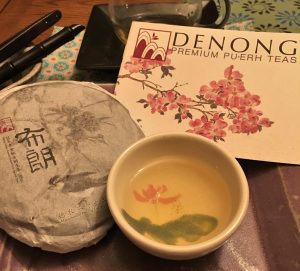
My third try of this tea was with two other tea enthusiasts.Such delicate tea requires precision in brewing and accurate water temperature (185° F or 85 ° C – follow the instructions on the package). The three of us enjoyed 15 brews, and were pleasantly surprised by how the flavor lingers!

What a fabulous clean tea and rare find! (Denong’s packaging was also delightful!) When you have such a great tea, it is so important to brew it correctly, and take your time to sip and enjoy.

But shouldn’t I already know about mindful drinking? It requires patience, focus, and leisure, which many of us in our busy schedules just don’t have! I’m again reminded of the wisdom that Tang monk, Ling Yi (灵一), shared with us more than 1000 years ago:

野泉煙火白雲間,Amidst wild spring bonfire and misty clouds,
坐飲香茶愛此山。Sipping fragrant tea in this beloved mountain.
岩下維舟不忍去,My tied boat underneath the rock lingers,
青溪流水暮潺潺。Till dusk along the clear floating steam.
Drop in Chinese Enrollment Requires Serious Reflections

Co-curricular experiential & cultural learning experience

I have read  more reports and heard from more colleagues these two years that the Chinese program enrollment numbers have either plateaued or decreased. At my university, enrollment has remained in general strong, however, we did see one of our smallest incoming 1st-year language classes this fall. I hope it’s just a blip and the numbers will bounce back next fall, but as most private higher ed institutions are facing enrollment drop, the prospect of continuing growth in Chinese program is looking grim.  My university has invested the past 30 years to build a solid Chinese program, and as one of the senior faculty members, I feel particularly responsible to ensure the program’s continuing success.

Here are some of the advices I have gathered in my research and readings, given by fellow teachers, administrators and researchers in the field:

1. Rethink course goals for beginning learners: motivation to continue vs. developing linguistic accuracy and fluency;
2. Identify more ways inside and outside classroom to motivate and engage students in the process of learning Chinese as a foreign language;
3. De-mystify the myth that “Chinese is too hard to learn”; re-evaluate course design to mollify learner anxiety; 
4. Develop pedagogy and resources for making learning Chinese an intellectually stimulating educational experience;
5. Better address learning issues within a class or a program facing
overwhelming number of students of Chinese background;
6. Increase campus advocacy; come up with creative and doable ways to recruit students;
7. Make study abroad more accessible especially for STEM students, and more affordable for all;
8. Find ways to change negative views of China among young Americans, … or wait until China’s pop culture and pop stars to gain more global recognition.

Serious reflections & discussions of these issues will help all of us in the field to better cope and correct the trend. I look forward to attending the 3rd Chinese Innovation Forum  tomorrow to network with colleagues to share ideas and learn.

Reference articles:
–  American Students Lose Interest in China Studies,  Nikkei Asian Review, April 15, 2017
–  
Why is China so …Uncool? George Gao, Foreign Policy, March 8, 2017.
–  A New Era for Chinese for Chinese Language,  Jennifer Walker,  July/August 2016 issue of International Educator magazine. 
–   Issues in Chinese Language Teaching in Australian Schools, Jane Orton, Chinese Education and Society, 
Volume 49, 2016 – Issue 6.
–  Tasks and Learner Motivation in Learning Chinese as a Foreign LanguageYoujin RuanXiaoju Duan &Xiang Yun Du,  Language, Culture and  Curriculum, Volume 28, 2015 – Issue 2.

Silver Teapot

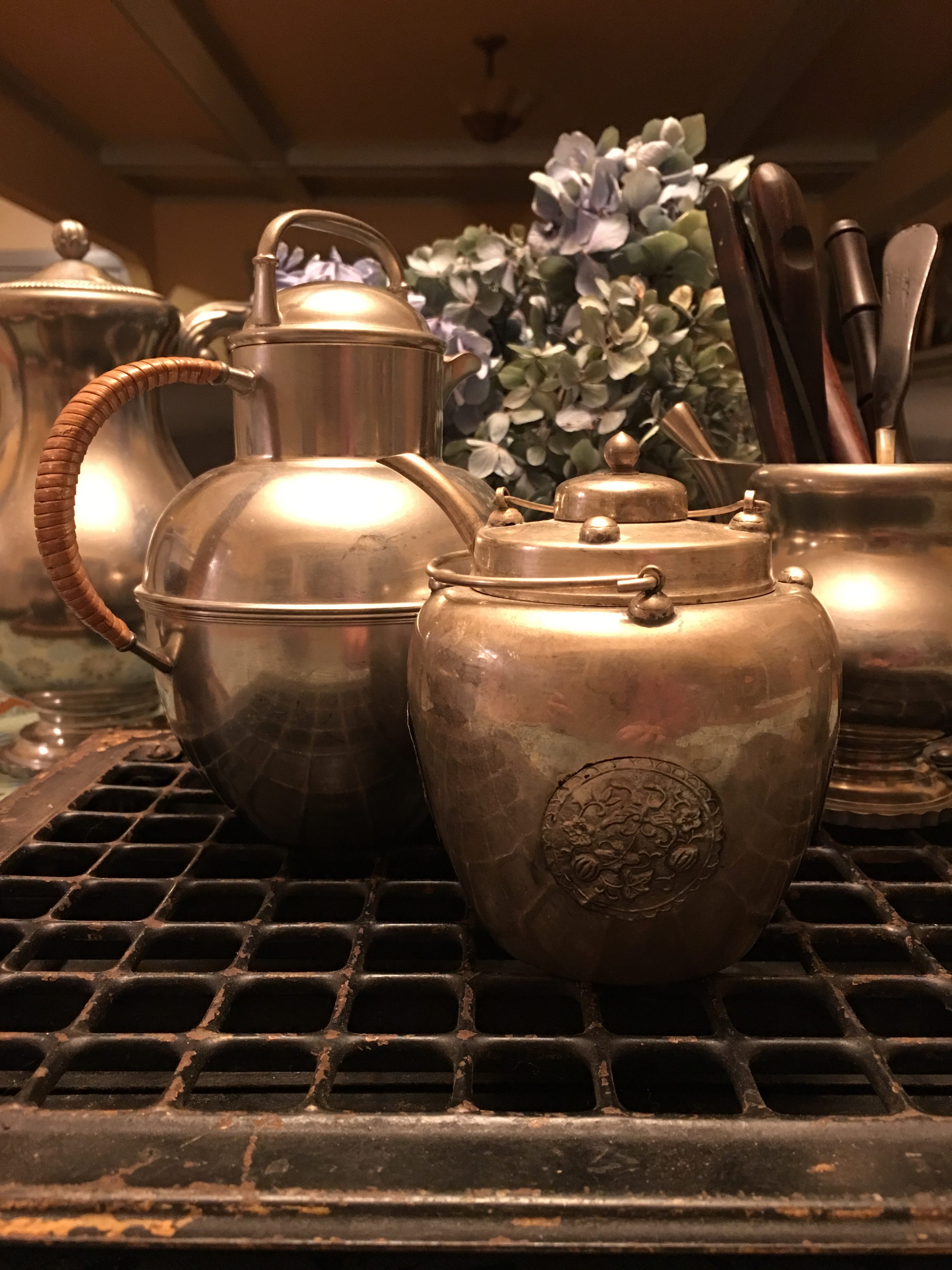
I have been in search of a good silver teapot for sometime. The Sage of Tea, Lu Yu,  more than 1,400 years ago, wrote about metal teapots, which were called “Fu” [鍑fǔ]. Fu was made out of cast iron, which was of course not the best materials for teapots . Porcelain and stone-made pots offer much cleaner inner surface but both are breakable, Lu Yu noted, and he praised silver pots as undoubtedly the best in this regard. “Silver tea pots are the cleanest.” [ 用銀為之,至潔,但涉於侈麗。] Silver is a rare metal and a luxury material for tea pots. It was true then and now.

I still don’t own a good silver teapot but I do have a random collection of vintage metal tea and coffee pots. Many of them are early 1900 Dutch or American-made  pewter (錫鉛合金) pieces, which I use for decorative purpose while serving Chinese tea. Old pewter pieces are interesting to look at but not safe to use as they contain lead. Such incongruous mix-and-match of the East and the West, I have found,  actually adds interest to one’s tea appreciation experience.

Go to Solid Silver Tea Pot Buying Guide to learn more about how to select a quality silver pot for your taste and needs. Tea Master’s Blog has a great entry about brewing Chinese tea in silver teapots.

The Seven Cups of Tea

I have been preparing for a presentation at our annul Chinese language teachers conference. Reading a few really great books about the history of Chinese Tea: John C Evans’ Tea in China: The History of China’s National Drink (1992); James A. Benn’s Tea in China: A Religious and Cultural History (2015); Bret Hinsch’s The Rise of Tea Culture in China:The Invention of the Individual (2016). Many late nights with cups  of tea. And when I read Tang Poet  Lu Tong’s stanza, I felt every bit of his sentiment:

【唐 盧仝〈七碗茶歌〉】

一碗喉吻潤。
兩碗破孤悶。
三碗搜枯腸,唯有文字五千卷。
四碗發輕汗,平生不平事,盡向毛孔散。
五碗肌骨清。
六碗通仙靈。
七碗吃不得也,唯覺兩腋習習清風生。
蓬萊山,在何處?
玉川子,乘此清風欲歸去。

The first bowl moistens my lips and throat.
The second bowl banishes my loneliness and melancholy.
The third bowl penetrates my withered entrails.
Finding nothing there except five thousand scrolls of writing.
The fourth bowl raises a light perspiration,
As all the inequities I have suffered in my life
Are flushed out through my pores.
The fifth bowl purifies my flesh and bones.
The sixth bowl allows me to communicate with immortals.
The seven bowl I need not drink,
I am only aware of a pure wind rising beneath my two arms.
The mountains of Penglai, what is this place?
I, Master of the Jade Stream, ride this pure wind and wish to return.

-James, A. Benn, Tea in China (Honolulu: University of Hawai’i Press, 2015), 14-15.

css.php